




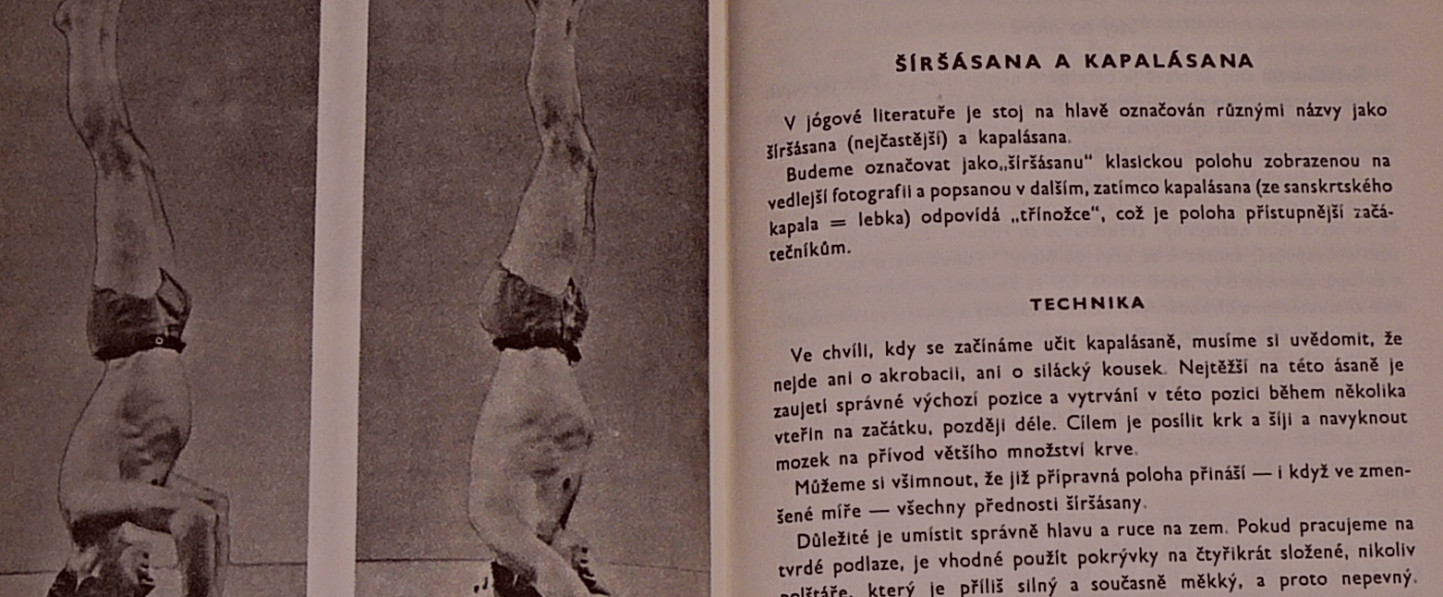

A different view on life and sex – by André Van Lysebeth
In the current boom of interest in tantra as an alternative philosophy offering insights that we, in the Western world, often lack, a wide range of books on the subject has emerged.
But how to navigate this flood of literature, often wrapped in enticing titles? There are many authors, and each is convinced that his approach is the only true one. Alongside valuable works, there also appear titles written purely in response to the demand for “spiritual literature on demand” – full of appealing, yet empty, phrases and slogans.
I will try to share my (subjective) presentation of books about tantra, therapy, philosophy, and personal growth.
I will begin with a book that, for some reason, has become one of the most widespread in the Czech Republic:
TANTRA – The Cult of the Feminine Principle, or A Different View on Life and Sex by André Van Lysebeth (1918–2004).
Some of you may know the author for his numerous works on yoga (I Learn Yoga, Perfecting My Yoga, Pranayama – The Technique of Breathing, etc.).
In his biography, he refers to several Indian gurus and institutes devoted to the scholarly study of yoga.
The blending of Eastern philosophy with Western narrative structure is characteristic of his writing – though for a typical European reader, it can at times seem rather chaotic. His academic style alternates between an informal tone and moments of high erudition. Practical advice on meditation, exercises, or sexuality is interwoven with remarks on archaeology, philosophy, and even physics — and then, suddenly, we find ourselves in the middle of a personal anecdote reminiscent of a school essay on “What I Did During My Summer Holidays.”
Overall, the book leaves a slightly uneven impression.
It was published in 1988, and although it deals with an ancient philosophy, some information, especially in the field of archaeology, is inaccurate. Nevertheless, I consider the time spent reading this nearly 500-page work worthwhile.
It remains one of the few Czech-translated books that attempt to summarize tantra in all its complexity — without reducing it to a mere method of improving sexual life.
The book is divided into eight chapters. The first ambitiously delves into the anthropological analysis of both Indian and European populations, somewhat unfortunately drawing on materials collected by Hitler’s scientists in the 1940s. It travels through history and reaches a description of the caste system, which gradually suppressed tantric traditions across the Indian subcontinent.
Then, suddenly, we find ourselves in the second chapter — an attempt to define tantra and its philosophical foundations. Here, the author’s desperate effort to defend tantric ideas using the words of Western philosophers and scientists (from Giordano Bruno to Descartes) becomes evident.
Although these intellectual constructions may sometimes appear far-fetched, I deeply understand the author’s intention. The European mind, though fascinated by mysticism, is fundamentally rational. It prefers logic, structure, clarity, and measurability — concepts that can be proven or disproven. Even Christian theology is, at its core, logically built.
Eastern philosophy, and especially tantra, does not consider our logic or our value-based hierarchy essential.
Van Lysebeth both praises this and simultaneously denies it by seeking validation in Western science. He strives to live a fascinating tantric life yet cannot renounce his European reasoning.
And still, I do not see him as a hypocrite. On the contrary, his work feels honest, supported by years of study and personal experience. Rational structure is deeply ingrained in our very genes; thus, a different approach from a Western author would feel unnatural and inauthentic.
The middle chapters (3–6) are more practical, focusing on breathing, physical exercises, meditation, and sexuality. They reveal his genuine curiosity and insight into the subject.
Many of these practices can easily be integrated into daily life and may enrich people of different temperaments and professions.
The final chapter confirms my interpretation of his concept of “the East within the West.”
He seeks ways to integrate a tantric approach into the life of Judeo-Christian society — a culture that often views itself as “civilized and correct,” yet is spiritually empty and hungry for new impulses.
A glossary of key terms at the end of the book is also a pleasant addition.
One of the key ideas of tantra is non-judgment; one of the key ideas of literary critique is, on the contrary, evaluation.
So I leave the dilemma to you, the readers.
Already at the beginning, I recommended this book to anyone wishing to understand tantra in its widest possible context — because no other work in Czech offers such comprehensive insight.
My final suggestion is simple: read it with an open mind, using not only the Western intellect but also the ancient talent of perceiving what is mystical, deep, demanding, and abstract.



Founder of Tantra masáže Praha s.r.o., psychotherapist, manager, lecturer of tantra and personal development groups, coach, yoga and holistic bodywork lecturer, massage therapist (10 years of practice), author of the "Inner wave" therapeutic tantric massage technique, massage lecturer.






























 Our Studio

